
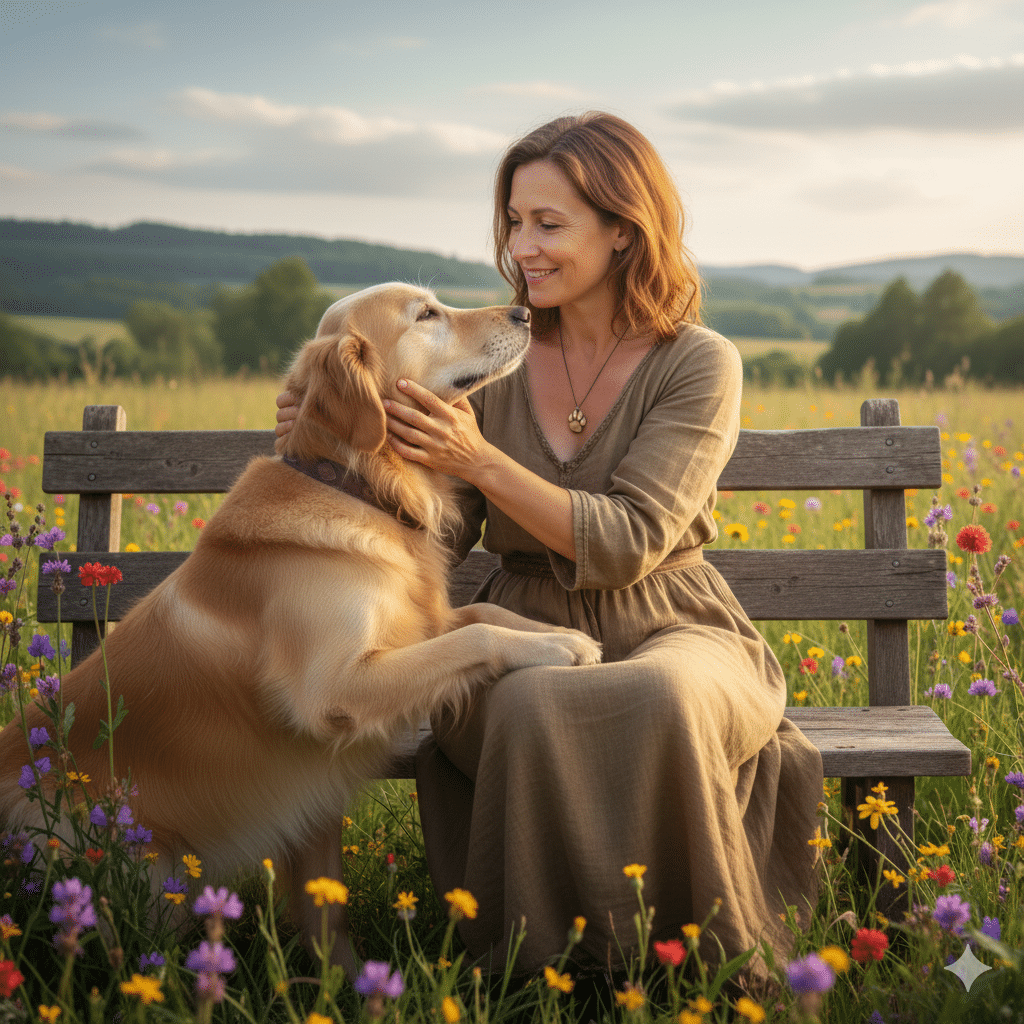
Expert mentoring for animal communicators becomes essential when you reach a point where basic training isn't enough anymore.
You know how to communicate.
So why do some cases still leave you stuck?
You're not new to this. You know how to connect. You receive information clearly. Animals respond to you.
And yet…
There are moments when you walk away from a situation thinking:
"I understand why this is happening, but I don't know what to do next."
"This feels more complex than what I was trained for."
If you've ever felt that quiet frustration — especially when an animal is still struggling — this is for you.
Because this isn't about lack of ability.
It's about hitting the edge of what you were taught.
The problem isn't your intuition — it's what you were never trained to do
Here's the part few people say out loud:
Learning how to communicate is only the beginning.
At some point, the challenge stops being getting information… and becomes deciding how to help when the situation doesn't resolve easily.
You start encountering cases where:
- behavior makes sense, but doesn't change
- the animal has layers you weren't taught to recognize
- "just tell them" doesn't work
- and doing nothing doesn't feel right
This is where many communicators quietly start doubting themselves.
Not because they've lost their connection — but because they've reached a level where intuition alone isn't enough.
What happens when you try to handle complex cases with basic level skills
When you're working on your own, it's easy to fall into one of two traps:
Stopping too soon
Telling yourself, "That's all I can do," even when your gut says there's more.
Over-efforting
Trying harder, repeating the same approach, hoping something will finally shift.
Neither of these serves the animal.
This means you've outgrown the basics and need more advanced training to uplevel your skills.
A story I see far too often
One student came to me after hiring several professional communicators for her dog's escalating bad behavior.
Each communicator received information. Each one told the dog to stop doing what it was doing. None of them asked why the behavior existed from the dog's point of view.
Nothing improved. The behavior escalated.
Tragically, the dog died. Still unheard. Still misunderstood. Still unrespected. Still trying to do the job she felt called to do for her family from her unique perspective.
When I communicated with her in spirit, she was clear about why she had done what she did and what she had been trying to protect.
When I shared that with her person, everything finally made sense. If only that heart to heart chat had happened before she died…
Because if that advanced level of conversation had happened earlier, the outcome could have been very different.
That's a failure of communication.
Because being able to serve animals at this advanced level requires you to go outside the box into next level thinking and develop better conversational skills.
And a failure of discernment, and discernment is something you can only learn through expert mentoring, not practicing all by yourself in isolation trying to figure it out on your own.
Why advanced communicators don't "outgrow" mentoring
In every serious field — medicine, therapy, music, athletics — advanced practitioners don't stop learning once they're competent.
True mastery in any discipline isn't achieved through experience alone — decades of research in expertise and performance show that high-level skill development requires deliberate practice, which is purposeful, feedback-oriented, and often guided by an experienced mentor.
Because the more skilled you become, the more context matters. The more nuance is revealed. The more the work requires of you.
You don't need more basics.
You need:
- perspective
- pattern recognition
- help seeing what you can't see from inside the case
- someone who knows how to widen the lens when things get stuck
One student once told me that watching how I decide what to do next in a session changed everything about how she worked.
Not because she learned a new technique but because she learned how to think differently in complex situations.
That's mentoring.
This is why community matters at advanced levels
When you're in a mentoring-based environment, you stop carrying uncertainty alone.
You get to:
- see how other cases unfold
- hear the questions that unlock movement
- recognize patterns across many animals, not just your own
- learn when communication is enough, and when it isn't
- and know what IS needed to get the best results
Your confidence stops being forced.
It becomes earned.
And animals feel the difference.
Why I learned this work the hard way and why I mentor differently now
Much of what I know today, I learned the hard way.
My intuitive abilities grew as a result of meditation practices I'd been doing for a long time.
In 1993 I was already doing successful animal communication work before I ever discovered Penelope Smith, the Grandmother of Interspecies Telepathic Communication.
Animal communication didn't emerge in a vacuum — it stands on the legacy of pioneers like Penelope Smith, who helped define and popularize animal communication as a field of study and practice. Her teachings and writings are foundational to anyone studying the subject.
Scientific inquiry into cognition and communication in animals has a long history. The field of trans-species psychology argues for shared cognitive and emotional capacities across species. Studies of chimpanzees like Washoe demonstrate that complex communicative behaviors can emerge in non-human animals, and foundational animal behavior science developed by researchers such as Konrad Lorenz continues to inform our understanding.
When I did find her, I trained with her for the foundational work, completed her advanced course, and was certified to teach her beginning class.
That training gave me an important grounding, and it also confirmed something I was already discovering in my own work.
There was still so much more that animals needed help with.
Beyond the basics of communication, there was no roadmap.
I didn't have the luxury of an experienced animal communication mentor to guide me through complex cases, especially frustrating when behavior didn't change, puzzling when health issues were layered and complex, or disappointing when situations fell outside anything I'd been taught.
So I did what the work required.
I studied widely. I trained in multiple healing and body-based modalities for people. I paid close attention to what helped, and what didn't.
And most importantly, I let the animals teach me.
Every animal showed me something. The easier cases confirmed what I knew. The harder ones forced me to dig deeper, ask better questions, and refuse surface-level answers.
When something didn't help, I kept going until I found what did.
That's how I learned to cast a wide net, to connect the dots from multiple modalities.
That's how I learned not to stop too soon.
That's how I learned to work successfully with situations that were layered, subtle, or unfamiliar.
Years later, when Penelope Smith chose to endorse my work in The Heart School of Animal Communication® and the Animal Talk Coaching & Mastery Club®, it wasn't because I was teaching the basics.
It was because she saw the depth, integrity, and effectiveness of how I mentor communicators to go further, ethically, responsibly, and with real results for animals.
That's why mentoring matters.
Because you don't need to reinvent the wheel the way I did.
Inside my mentoring work, I pass on the discernment, pattern recognition, and decision-making that took me decades to develop.
This depth of training is what you'll find in The Heart School of Animal Communication®, where I've created comprehensive courses and ongoing support specifically designed to help communicators develop these advanced skills.
The principles and practices I share are also detailed in my #1 internationally bestselling book, Advanced Animal Communication with the Heart Wisdom Method®, where I walk through real cases and the decision-making process that makes the difference.
I do this so you can grow faster, with more clarity, and without having to struggle alone through every hard case.
That's the difference between learning in isolation… and learning with an experienced mentor who's already walked the path.
If this resonates, you're ready to become a better communicator
If you're reading this and thinking: "Yes. This is exactly where I am."
That's not a problem.
It's a sign you're ready to grow beyond the limits of what you were taught and into a level of work where animals receive deeper, more meaningful support.
You don't need to do this alone.
And animals benefit much more when you don't try to figure it out in isolation like I did for 30 years.
If you're an animal communicator who wants to:
- handle complex cases with more clarity and get better results from your work
- stop second-guessing your decisions and improve your confidence and accuracy
- and learn how to go further when animals need more
You can explore The Heart School Online Courses, Club Membership and Training Hub to find the level of support that's right for you.
The Animal Talk Coaching & Mastery Club® is a mentoring-based learning environment where real cases are explored, decision-making is modeled, and communicators learn how to think, not just listen.
Inside The Heart School Online Courses, Club Membership and Training Hub, you'll find comprehensive training that builds on the principles shared in my #1 bestselling book, Advanced Animal Communication with the Heart Wisdom Method®.
👉 Learn more here: Animal Talk Coaching & Mastery Club®
Because doing better work for animals requires more than intuition.
Take advantage of this unique opportunity to mentor with an expert, because I figured this out the hard way so you don't have to.


Leave a Reply