
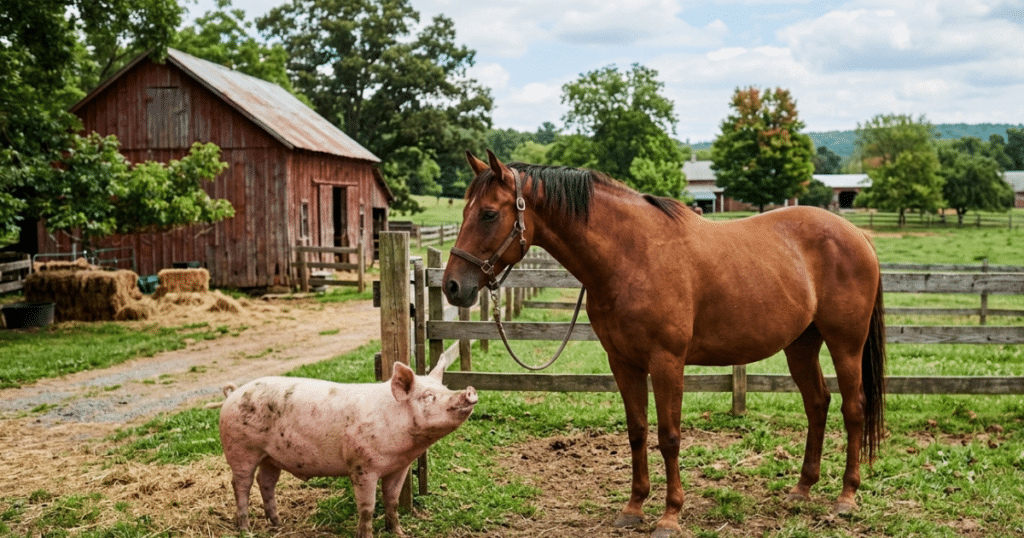
One of my professional animal communication students Elizabeth shared a story that perfectly captures what animal communication skills actually look like when it counts, not in a quiet practice session, but in a full-blown farmyard emergency.
Because it was one of those moments where you don't have time to "do it perfectly."
You just need it to work. (Pig included.)
The Pig in the Pasture (And What Happened the First Time)
Here's what happened:
A neighbor's pet pig wandered into their horse pasture.
Chaos broke out.
Horses tried to stomp the pig.
Pig squealing frantically.
Elizabeth grabbed a big stick. Someone yelled. Someone ran. Everybody panicked.
And Elizabeth said something so honest I swear every animal communicator on Earth has done this at least once:
"I totally forgot I even knew how to do animal communication." 😂
It took 45 minutes to get the pig to safety… and another 15 minutes to calm the horses down.
Same Pig. Same Pasture. Completely Different Outcome.
Fast forward to a week later.
Same errant piggie. Same horsey pasture. Same potential chaos brewing trouble situation.
But this time Elizabeth remembered what she's been practicing.
She took a breath.
Got into her heart space.
And internally, energetically, broadcast with a huge yell:
And everyone stopped. The horses stopped. The pig stopped. Everybody looked at her like a frozen tableau scene from the Matrix.
Within minutes, Elizabeth had the pig safely out… and the horses calm… without tree branches, sticks, or a nervous system meltdown.
Smokey (one of the aforementioned deeply offended horses) even walked up and sniffed the pig.
That is what I mean when I say:
This isn't just about "learning animal communication."
It's learning how to stay fully present when it counts.
Why I'm Telling You This
Because a lot of beginner animal communication students think the hard part is getting connected.
Then they get better at that, and they encounter other "hard" parts as they grow their skills and experience.
But the real "sticky" parts come in crisis moments — those times when you forget everything you ever learned in a panic situation.
The Four Common Blocks That Hold Communicators Back
That's why we've been talking about these common blocks:
- The Intuitive Block — why it goes quiet sometimes
- The Interpretation Block — why it gets fuzzy after the session
- The Client Block — why people sometimes want more than you can give
- The Energy Drain Block — why you feel wrung out afterward
Elizabeth didn't "get better" because she tried harder.
She got better because she had a moment where her system remembered what I've been teaching her:
And that's the part most training leaves out.

Recognizing a pattern in your own practice? Start here — it's free:
Becoming a Better Animal Communicator By Avoiding These 4 Common Mistakes — the habits that quietly block connection even when you know what you're doing.
The Missing Pieces Nobody Taught You
This is exactly what my student Nita described so beautifully.
She said she took other classes and read books for years… but still felt like she had little to show for it.
Not because those trainings were "bad," but because there were missing pieces.
And those missing pieces were things like:
- How to grow through real practice (with feedback)
- How to work with energy and emotional presence
- How to handle intense situations (transitions, trauma, fear)
- How to keep your field clear
- How to keep your confidence when the mind starts talking trash
(And yes, the mind will talk trash. It's very committed to exercising that entertaining hobby.)
You're Not Behind — You're Simply in the Part Most People Never Get Help With
If you've been thinking:
"Why is this clear one day and foggy the next?"
"Why do I feel great in the moment… then doubt everything later?"
"Why do I freeze when things get intense?"
You're not alone. You're not "behind."
You're simply in the part of learning that most people never get help with.
And that's why it matters that we name these patterns.
Because when you can see what's happening, you stop taking it personally.
And you start getting your footing.
And things start working better. Imagine that. 😇
What Comes Next
Next let's talk about the one that hits people square in the feels, read the next post in this series:
It usually comes down to something very specific:
The container wasn't set properly.
And the good news? That's fixable. 💛
Want Support Becoming a Better Animal Communicator?
If Elizabeth's story resonates — if you've ever frozen in a moment that mattered, or felt like you had more to give but didn't know how to access it — you're not alone. And you don't have to figure this out in isolation.
Inside the Animal Talk Coaching & Mastery Club®, you're not left to figure things out on your own.
This is a mentoring-based learning environment where you'll experience expert mentoring through real cases, not hypotheticals, live Q&A coaching classes where decision-making is modeled step by step, guidance on when communication is enough and when something more is needed, and a thoughtful community of communicators who are committed to doing better work.
This is where communicators learn how to stay present under pressure, grow through real feedback, and build the kind of confidence that shows up when it counts — even when a pig is in the pasture.
Learn More About the Animal Talk Coaching & Mastery Club®Continue Your Learning Journey
Why Animals Won't Talk to You
Discover why animals go quiet and what's really happening when your intuitive connection suddenly feels blocked or silent.
Am I Making This Up? Why You Doubt Your Animal Communication
If the impressions come through clearly and then you immediately second-guess them, this explains what's really going on.
When Animal Communication Doesn't Work to Change Behavior
Why understanding what an animal says isn't always enough — and what experienced communicators do differently when things don't shift.


Leave a Reply